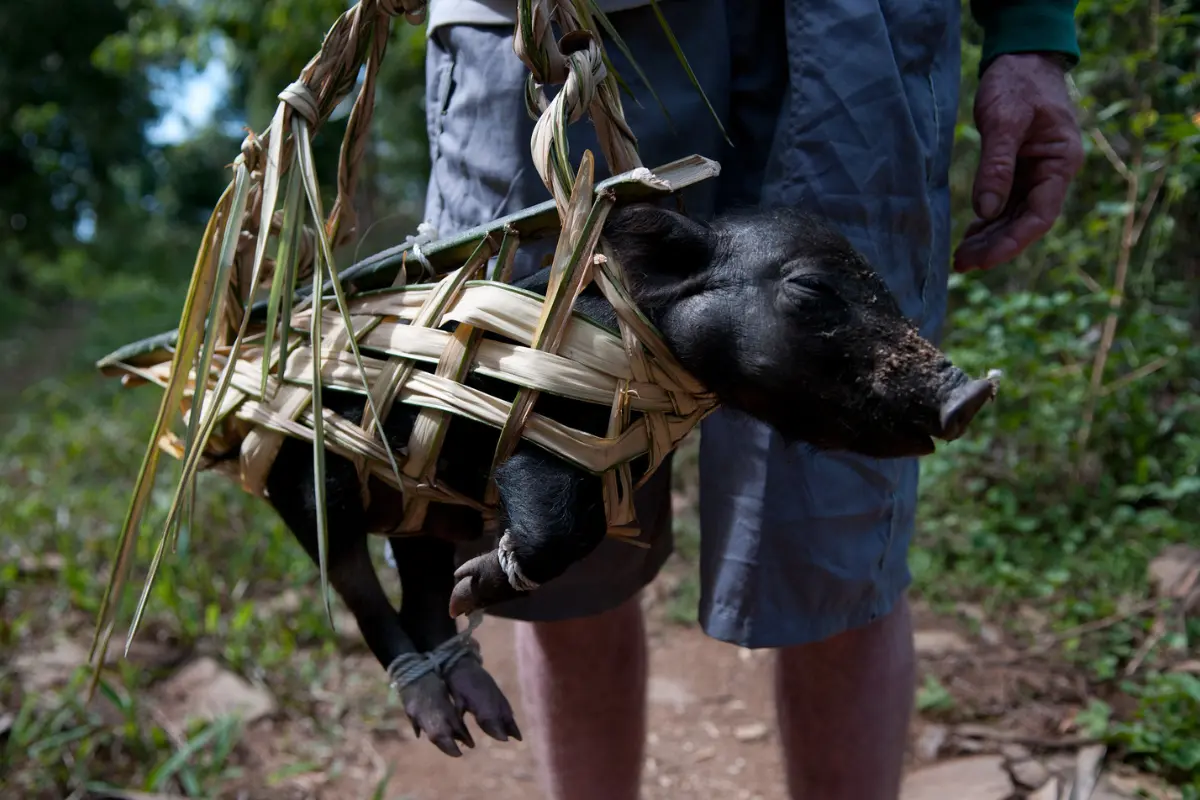
Pig for the feast, East Nusa Tenggara, Indonesia. Photo by Aulia Erlangga/Landscape Alliance
By Daniella Silva
13 May 2026 — A new research community calls for more interdisciplinary and systems-informed research
“In the forests of the Congo Basin, a man is checking a wire snare before dawn. What he brings home tonight may be the only animal protein his family eats this week.
[At the same time], in the markets of Kinshasa, a woman is paying a premium for smoked antelope because it is what her mother served and her mother’s mother before her.
And somewhere in a conference room, a conservationist is arguing that both of these people are driving a species to extinction.
All three of them are right,” said Robert Nasi, Director of Science at Landscape Alliance, at the first Wild Meat Dialogues webinar for Asia and the Pacific. Although these examples come from Africa, the discussions showed how they are representative of the complex social and ecological drivers of wild meat use globally.
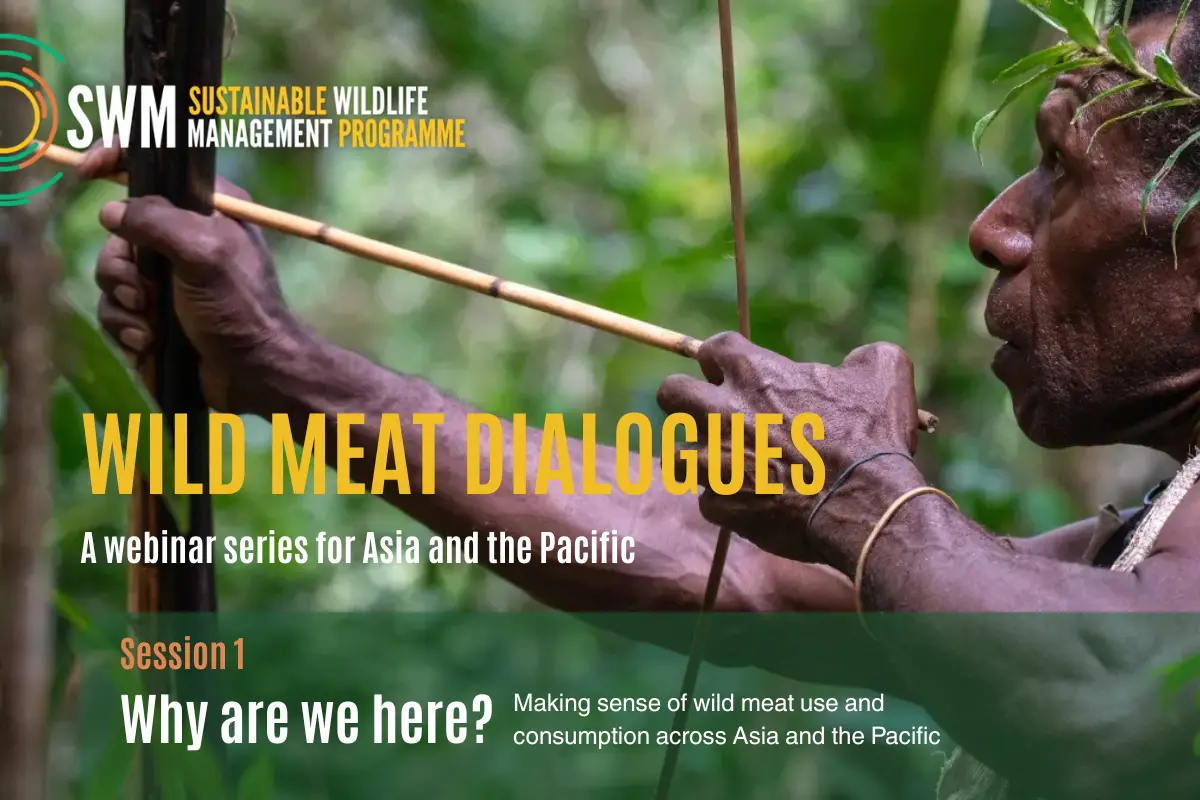
The Wild Meat Dialogues is an initiative of the Sustainable Wildlife Management (SWM) Programme that aims to build a community in Asia-Pacific around regional wild meat research, closing knowledge gaps and contributing to better informed policies and community-based wildlife management.
The first session asked, “why are we here?” and laid out the rationale for more collaborative research and practice on this topic.
What we do and don’t know
Wild meat sits at the intersection of a plethora of issues including biodiversity conservation, sustainable livelihoods, zoonotic disease risks and food security and nutrition.
A global survey found an estimated 150 million households in the global south harvest wild meat for essential daily protein, income and micronutrients such as iron and zinc for rural populations. But overexploitation, driven by increased demand for wild meat, habitat loss and climate change, are contributing to “empty forests” that look healthy from above but are functionally dead, stripped of their vertebrate populations.
Understanding wild meat value chains and trends provides valuable insights to communities and governments about how to sustainably, equitably and safely manage wildlife and monitor changes in the ecosystem.
“[In Asia and the Pacific] we don’t yet have a clear regional picture of how wild meat value chains function, what their impacts are, and what the greatest risks and opportunities are,” said Manon Mispiratceguy, FAO Regional Coordinator for Asia and the Pacific, in her opening address.
The knowledge gaps in Asia and the Pacific are particularly important to address because of the region’s high biodiversity, high hunting rates, and extensive wildlife trade networks. There have also been several zoonotic disease outbreaks in the last couple decades linked with wild meat use.
Jasmine Willis, PhD scholar at University of Oxford and researcher at Landscape Alliance, shone some light on these gaps, presenting findings from a systematic mapping exercise she and her colleagues conducted to understand wild meat use in SE Asia between 2000-2023. They found:
A growing body of research: Research on wild meat increased substantially around 2019-20, with publications peaking in 2021.
Research efforts are uneven: A high number of studies focused on Vietnam and Indonesia, while the least researched countries were Singapore, Brunei, Timor Leste with one study each.
A greater focus on “what” rather than “why”: Most studies from the region are descriptive, documenting quantity, hunting frequency and wild meat prices. There is less research available on social drivers, effectiveness of behavioral interventions, zoonotic disease mitigation, and taboos or decision processes that shape wild meat trade and consumption.
Few studies used mixed methods or interdisciplinary approaches
The ongoing gaps in location-specific data and social drivers matter: Policies that move forward without a good understanding of the way that social and ecological systems interact, or which are not grounded in context-appropriate research risk failure. Willis and the other presenters recommended moving beyond descriptive research to interdisciplinary and systems-based research that closes knowledge gaps and improves effective policy interventions.
Case studies: Zoonotic risks, flying foxes and subsistence hunting
Following the framing presentations, Kim Sookee, a forest and biodiversity intern at FAO moderated three lightning talks from Vietnam, New Caledonia and Papua and a panel discussion.
In Vietnam, Country Director for the Wildlife Conservation Society (WCS), Hoang Thuy, described the ongoing challenges in mapping the wild meat value chain and the zoonotic risk involved in these supply chains. While they have tracked wild meat and pet trade via online posts, they have not yet been able to measure the volume of wild meat going straight to restaurants and are planning more community-based research to close this gap. Echoing Willis’s earlier presentation, she noted that they need more data on the socio-ecological drivers of wild meat trade in the country.
Malik Oedin, Chief District Forest Officer and President at Guardiens des Iles, focused his talk on flying foxes in New Caledonia, where their meat is considered both a delicacy and an important part of Indigenous ceremonies. In some cases, communities also use the bones and hair of flying foxes as a form of currency. Hunting has become unsustainable, however, and the population of flying foxes is decreasing. Oedin and his team are training environmental services staff and consulting with communities, poachers, government ministers and other stakeholders to forge sustainable futures for this species.
Meanwhile overexploitation of wild meat has not yet become a problem in Papua, according to Freddy Pattiselanno, Head of the Institute of Research and Community Services at the Universitas Papua, Indonesia. Almost all consumption and trade are for subsistence, and there are strong traditional norms for sustainable use.
Next steps
The first Wild Meat Dialogues session was only an introduction. To continue answering the question of what we do and don’t know about wild meat in Asia and the Pacific, future dialogues will move from understanding the context, to identifying solutions, existing tools, and connecting research to policy.
Acknowledgements
The SWM Programme is a major international initiative that aims to improve the conservation and sustainable use of wildlife in forest, savannah and wetland ecosystems. It is funded by the European Union, with co-funding from the French Facility for Global Environment (FFEM) and the French Development Agency (AFD). Projects are being piloted and tested with governments and communities in 16 participating countries. The initiative is coordinated by a dynamic consortium of four partners, led by the Food and Agriculture Organization of the United Nations (FAO) with Landscape Alliance (formely known as the Center for International Forestry Research and World Agroforestry (CIFOR-ICRAF)), the French Agricultural Research Centre for International Development (CIRAD) and the Wildlife Conservation Society (WCS).