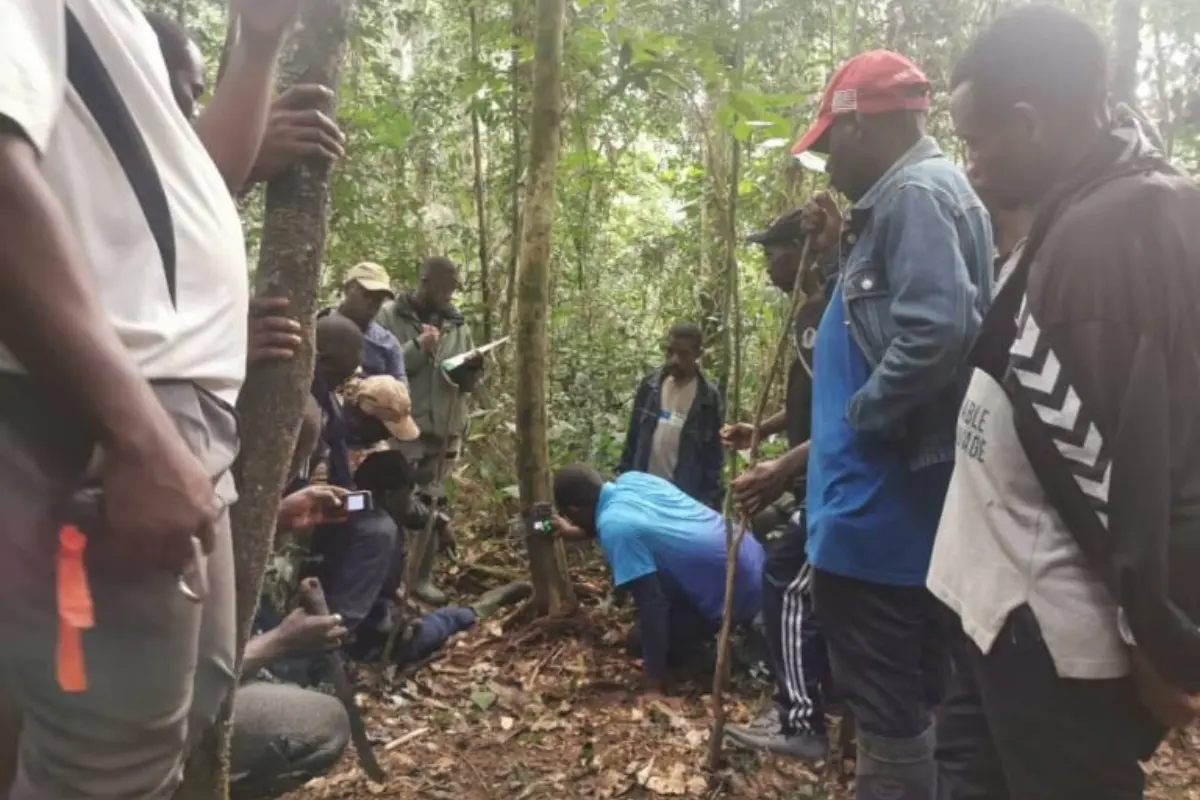
Field agents receive hands-on training in camera trap installation and biodiversity monitoring during a WildMon workshop in Cameroon’s Mintom landscape. Photo by WildMon.
By Julia E. Fa
This content was originally posted on Forests News
8 Jun. 2026 — Southern Cameroon’s Mintom landscape is a stronghold for biodiversity in Central Africa. This vast tropical forest supports a remarkable variety of life, from forest elephants and great apes to pangolins, blue duikers, frogs and countless other species. Yet this ecological richness faces growing pressure from human activities. Unregulated hunting, habitat fragmentation, agricultural encroachment, illegal mining and infrastructure development are accelerating the erosion of wildlife populations and ecosystem health.
In response, the Sustainable Wildlife Management (SWM) Programme is implementing a comprehensive biodiversity assessment across the Mintom landscape. This initiative is designed to do more than record declines; it aims to generate robust, site-specific data that informs conservation priorities, guides sustainable management practices and lays the foundation for new forms of biodiversity financing.
Laying the foundation for biodiversity financing
The SWM Programme team has adopted a three-stage assessment framework that integrates ecological research, community knowledge and spatial analysis. The first stage frames the system, defining what is being monitored, the scale and scope of measurement, and the potential application of results to conservation credit systems. The framing stage also establishes timelines, sets site-based targets, and determines how value might be attributed to different areas or species. For example, tiered credit systems linked to ecological importance can help determine value.
The broader goal of this work is not only to inform conservation strategies in Mintom but to build the methodological foundation for biodiversity crediting — a system in which conservation outcomes can be verified, valued, and potentially financed. As global interest in biodiversity markets continues to grow, the demand for credible, science-based metrics will only increase. The approach being developed in Mintom offers a model that is ecologically rigorous, locally relevant, and adaptable across different ecological and cultural contexts.
Acknowledgements
The camera trapping and analysis at SWM Programme sites in Cameroon were carried out in partnership with Map of Life and WildMon. Acoustic monitoring, camera trap monitoring, and AI analysis are provided through Wildmon, while Map of Life Solutions facilitates the eDNA sampling, lab processing, and data integration to produce species distribution models that power standardized metrics.
Map of Life Solutions is powered by the science of the Center for Biodiversity and Global Change at Yale University. Their partnership with CIFOR-ICRAF is funded by the European Commission (EC) and facilitated through the SWM Programme.
WildMon is a nonprofit organization led by global experts in ecology and conservation technology. By combining biodiversity data from tools such as ecoacoustics and camera traps with AI-powered analysis, WildMon turns ecological information into practical insights for conservation. Its tools and services help reduce technical barriers and support the people and organizations closest to nature, strengthening their ability to autonomously monitor and safeguard biodiversity.
The SWM Programme is a major international initiative that aims to improve the conservation and sustainable use of wildlife in forest, savannah and wetland ecosystems. It is funded by the European Union, with co-funding from the French Facility for Global Environment (FFEM) and the French Development Agency (AFD). Projects are being piloted and tested with governments and communities in 16 participating countries. The initiative is coordinated by a dynamic consortium of four partners, led by the Food and Agriculture Organization of the United Nations (FAO) with Landscape Alliance (formely known as the Center for International Forestry Research and World Agroforestry (CIFOR-ICRAF)), the French Agricultural Research Centre for International Development (CIRAD) and the Wildlife Conservation Society (WCS).