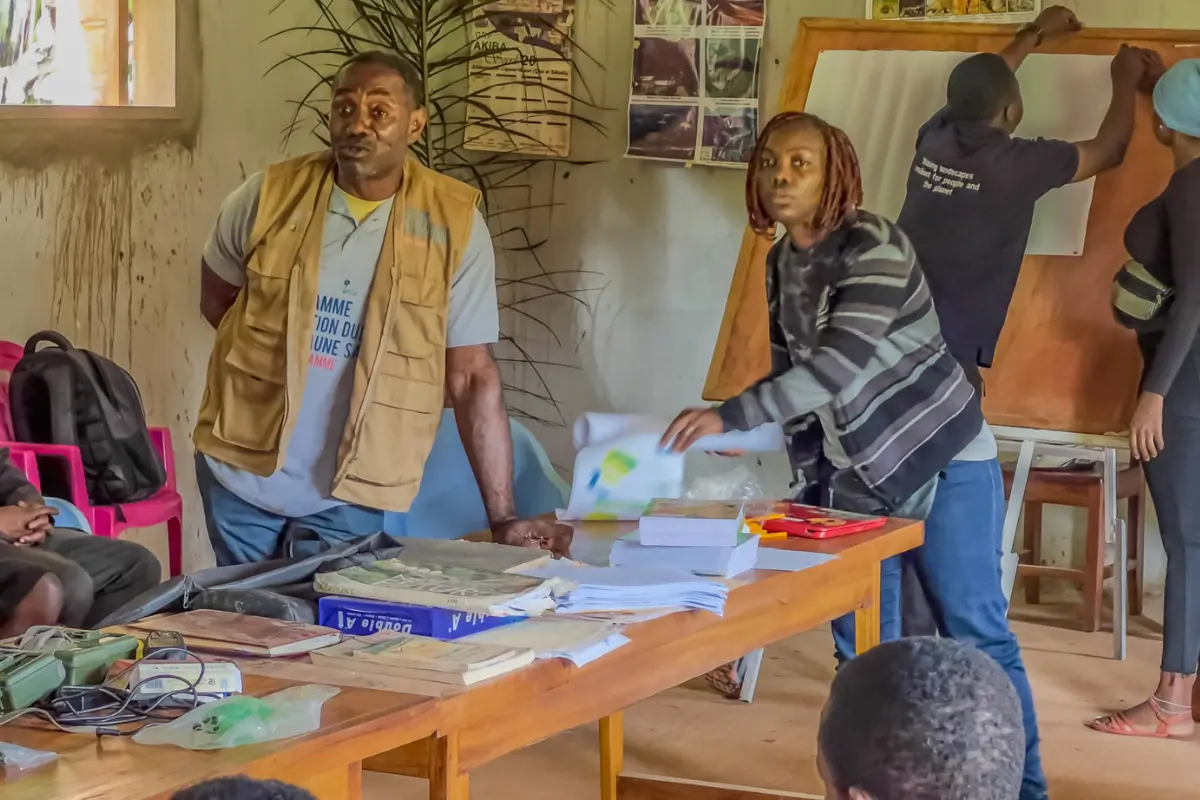
Robert Okale, also known as ‘Petit Robert,’ addresses workshop participants. Photo by Laureanne Mefan / CIFOR-ICRAF
By Julia E. Fa
This content was originally posted on Forests News
22 May 2026 — In the lush, biodiverse forests of southeastern Cameroon, conservation is not just a technical challenge — it is a cultural, ecological and historical negotiation. At the centre of this negotiation is local knowledge, passed down through generations of people whose lives are closely tied to the land and the animals it harbours.
The Sustainable Wildlife Management (SWM) Programme in Cameroon works directly with these communities through a community-rights-based approach that brings together science, traditional knowledge and community rights, resulting in stronger natural resource management. At the heart of the programme’s operations is Robert Okale, the project’s field coordinator and long-time para-ecologist.
“It’s very important to work with local communities because they are both the primary beneficiaries and, equally, the first victims of environmental challenges,” said Okale. “As researchers and technical experts, we bring scientific knowledge, but river communities hold practical and traditional knowledge. That’s why it’s essential to involve them in our work.”
Known affectionately by colleagues and community members as Petit Robert — a nickname that belies both his physical stature and his outsized role in the project — Okale brings decades of field experience. His deep familiarity with the region’s flora and fauna is matched only by his enduring relationships with Bantu and Baka communities across the forest landscape.
Acknowledgements
The SWM Programme is a major international initiative that aims to improve the conservation and sustainable use of wildlife in forest, savannah and wetland ecosystems. It is funded by the European Union, with co-funding from the French Facility for Global Environment (FFEM) and the French Development Agency (AFD). Projects are being piloted and tested with governments and communities in 16 participating countries. The initiative is coordinated by a dynamic consortium of four partners, led by the Food and Agriculture Organization of the United Nations (FAO) with Landscape Alliance (formely known as the Center for International Forestry Research and World Agroforestry (CIFOR-ICRAF)), the French Agricultural Research Centre for International Development (CIRAD) and the Wildlife Conservation Society (WCS).