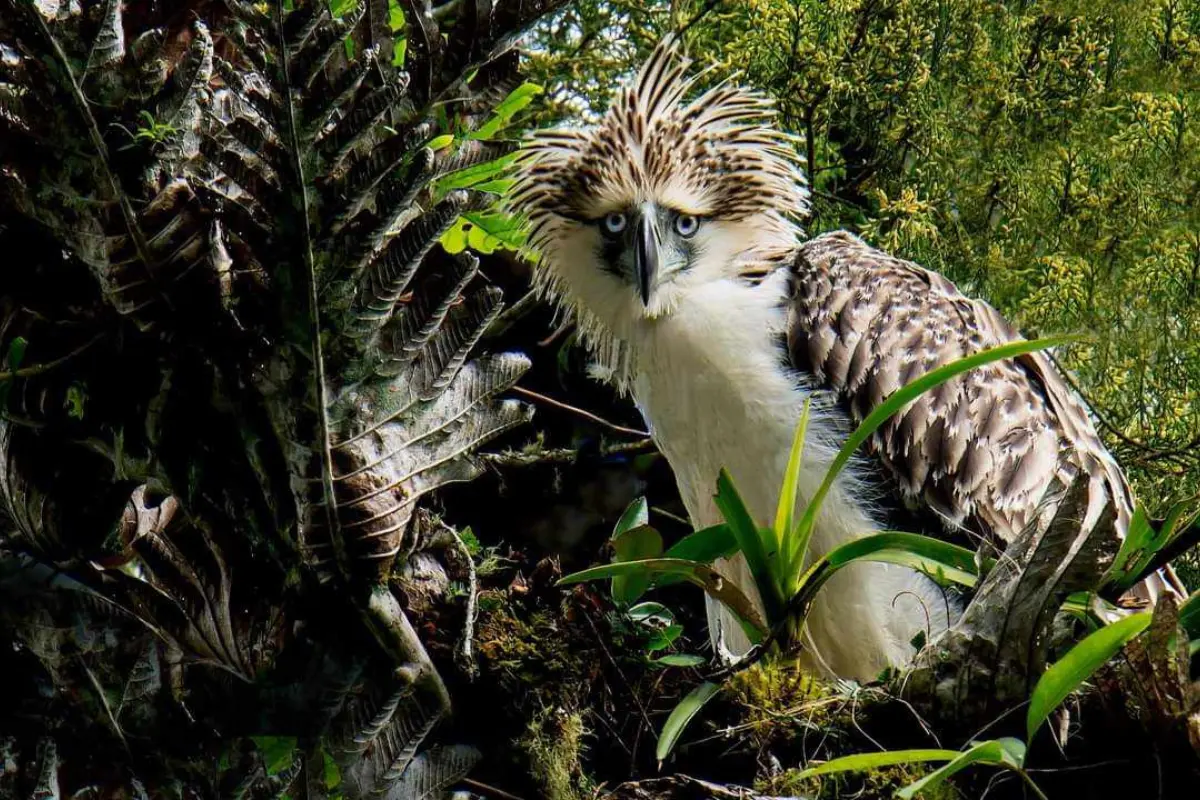
Philippine eagle in its forest habitat. Photo by Aimee Valencia
This content was originally posted on Forests News
The Philippines is home to one of the world’s largest and most powerful forest raptors: the Philippine eagle (Pithecophaga jefferyi). However, over the past decades, the species has been edged closer to extinction. Through one of its newest projects in the Philippines, Landscape Alliance and its partners are reinforcing why biodiversity conservation requires seeing beyond a single species and its habitat and working with the people who live alongside them.
What makes the Philippine eagle valuable?
Endemic to the Philippines, the Philippine eagle is a rare bird species that lives in forests up to 2,000 metres above sea level, often in steep terrain. It usually builds its nests in large, towering native dipterocarp trees, such as white lauan (Shorea contorta). It can also sometimes be seen in secondary growth and riparian forests, though not in open-canopy forests, where the risk of conflict with people may be higher. Its usual prey include monitor lizards, snakes, bats, palm civets and monkeys, which are also commonly found in these forests.
The raptor is also considered an ‘umbrella species’ because of its large habitat needs. Protecting the Philippine eagle also helps protect smaller, less-mobile species that share its habitat. As an apex predator, meaning it sits at the top of the food chain and has no natural predators of its own, it helps prevent some prey species from becoming too abundant, helping maintain balance in forest ecosystems. This makes the Philippine eagle a flagship species for biodiversity conservation in the Philippines.
Conserving the Philippine eagle means protecting its habitat, including by rebuilding forests with native tree species. In return, healthy forests support more stable ecosystems.
Officially declared the Philippines’ national bird under Proclamation No. 615, the Philippine eagle is valued for its ecological role and as part of the country’s cultural and biological heritage.
Acknowledgements
Nature’s Neighbours is a four-year project (2025–2029) funded by the United Kingdom Biodiversity Conservation Fund through the Darwin Initiative. Implemented by Landscape Alliance (formerly CIFOR-ICRAF) in partnership with Botanic Gardens Conservation International and the Philippine Eagle Foundation, the project supports sustainable coexistence between Indigenous Peoples and the Philippine eagle in San Fernando Municipality, Bukidnon Province, Philippines. For more information, visit https://www.cifor-icraf.org/project/naturesneighbors/.