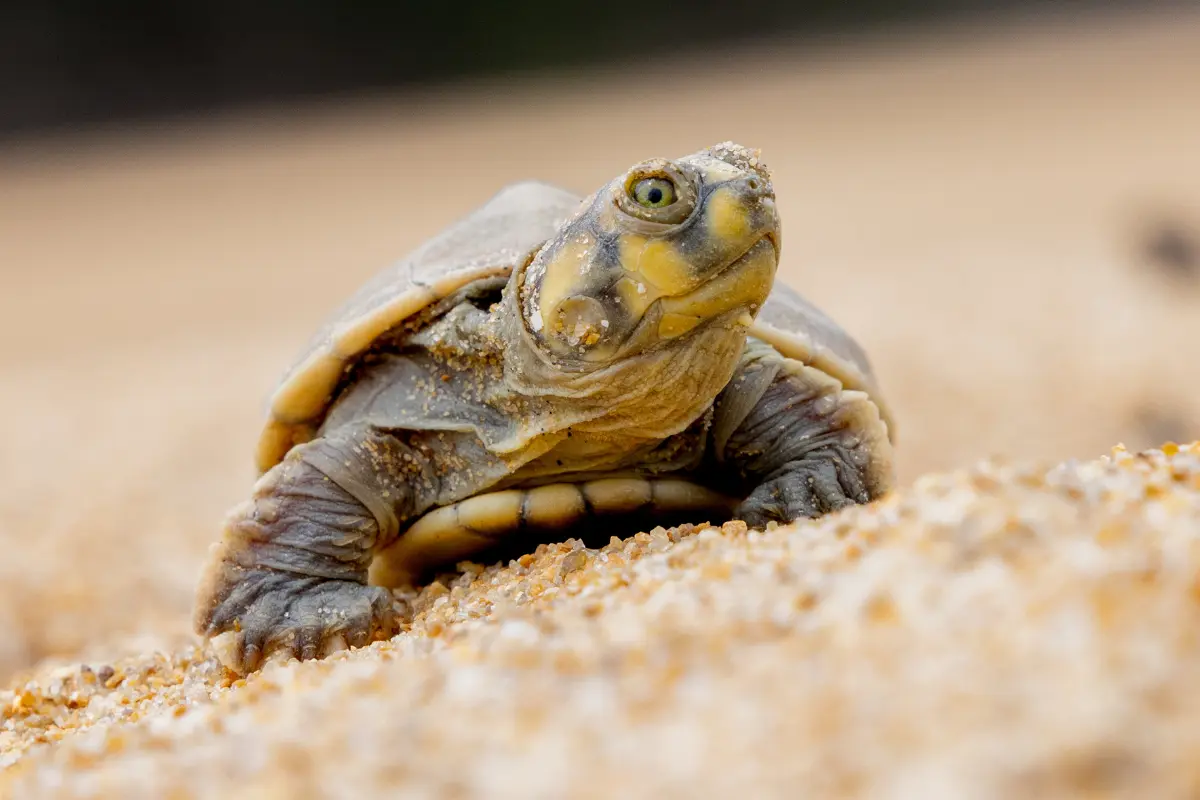
Yellow-spotted river turtle hatchling. Photo by Luke McKenna/FAO
May 2026 — Between 2021 and 2025, community-led conservation efforts in the Rumpununi region, Guyana, rescued and hatched more than 18,000 freshwater turtle eggs.
This accomplishment is thanks to a partnership between the Sustainable Wildlife Management (SWM) Programme, the South Rumpununi Conservation Conservation Society, Caiman House and 26 Indigenous communities.
Since launching, the initiative has employed 123 rangers and engaged five local communities across 131 beaches.
Why it matters
The Rumpununi region in Guyana has experienced rapid declines in freshwater turtle populations due to climate impacts (flooding), the pet trade and overharvesting for wild meat. Several of the six turtle species are at increased risk of extinction, including the giant South American river turtle (Podocnemis expansa) and the yellow-spotted river turtle (Podocnemis unifilis).
The community-led conservation efforts in Guyana give river turtles a fighting chance, protecting the eggs and caring for them until they hatch and can be released back into the wild. The team is also engaging in environmental education efforts to raise awareness with children and teens.
What’s next for freshwater turtle conservation?
In 2025, the SWM Programme published The Rupununi Freshwater Turtle Management Plan, which outlines six coordinated management options for local communities and other stakeholders: i) in situ nest protection; ii) next relocation and head-starting; iii) research; iv) environmental education, v) behaviour change and awareness raising; and vi) rules and guidelines.
With the SWM Guyana ending this year, the partners hope that the efforts for turtle conservation will continue long into the future.
Acknowledgements
The SWM Programme in Guyana is implemented by the Guyana Wildlife Conservation and Management Commission in coordination with the Center for International Forestry Research and World Agroforestry (CIFOR-ICRAF).
The SWM Programme is a major international initiative that aims to improve the conservation and sustainable use of wildlife in forest, savannah and wetland ecosystems. It is funded by the European Union, with co-funding from the French Facility for Global Environment (FFEM) and the French Development Agency (AFD). Projects are being piloted and tested with governments and communities in 16 participating countries. The initiative is coordinated by a dynamic consortium of four partners, led by the Food and Agriculture Organization of the United Nations (FAO) with the Center for International Forestry Research and World Agroforestry (CIFOR-ICRAF), the French Agricultural Research Centre for International Development (CIRAD) and the Wildlife Conservation Society (WCS).