
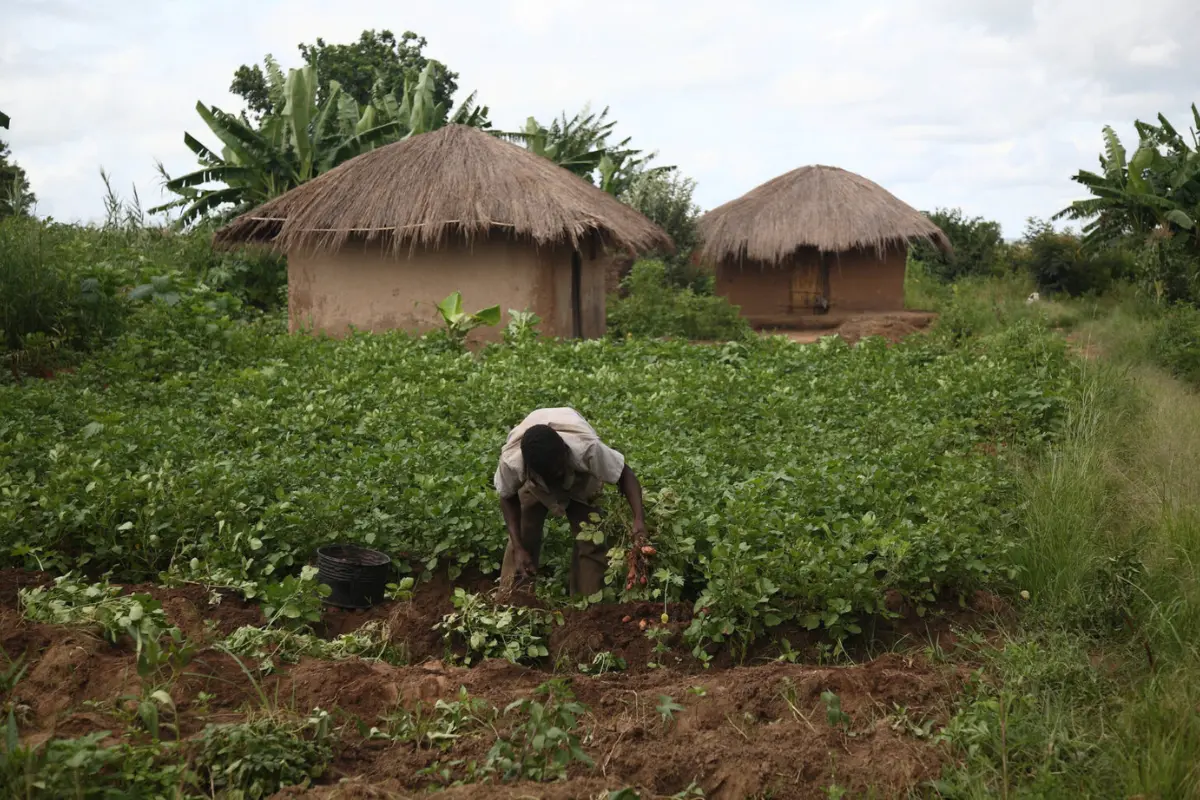
Photo: A farmer works in a field in central Malawi. CIFOR-ICRAF
29 April 2026 — A blog on Forests News interviewed Lessah Mandaloma, researcher at the University of Oxford, to discuss how the expansion of conservation areas in Malawi often conflicts with people’s needs for food security and economic development.
Her recent publication in Conservation Science and Practice explores how communities around Kasungu National Park believe future scenarios for conservation and agricultural policies — including fertilizer subsidies and farmer compensation schemes for crops that are damaged by wildlife — could shape outcomes.
The study concluded that conservation priorities can only be met if policies meaningfully engage local communities and fairly address their needs.
“In this landscape, conservation decisions often prioritize ecological outcomes,” said Mandoloma. “Often, they don’t fully account for local livelihoods, governance realities or social outcomes, even though these ultimately determine whether conservation succeeds or fails.”
Acknowledgements
The study behind this blog was supported by the Government of Malawi, Lilongwe University of Agriculture and Natural Resources (LUANAR), CIFOR-ICRAF, and the Biology Department, University of Oxford with additional funding from the UK Research and Innovation’s Global Challenges Research Fund (UKRI GCRF) Trade, Development and the Environment Hub project and the Research England International Science Partnership Fund (ISPF) Institutional Support (ODA).