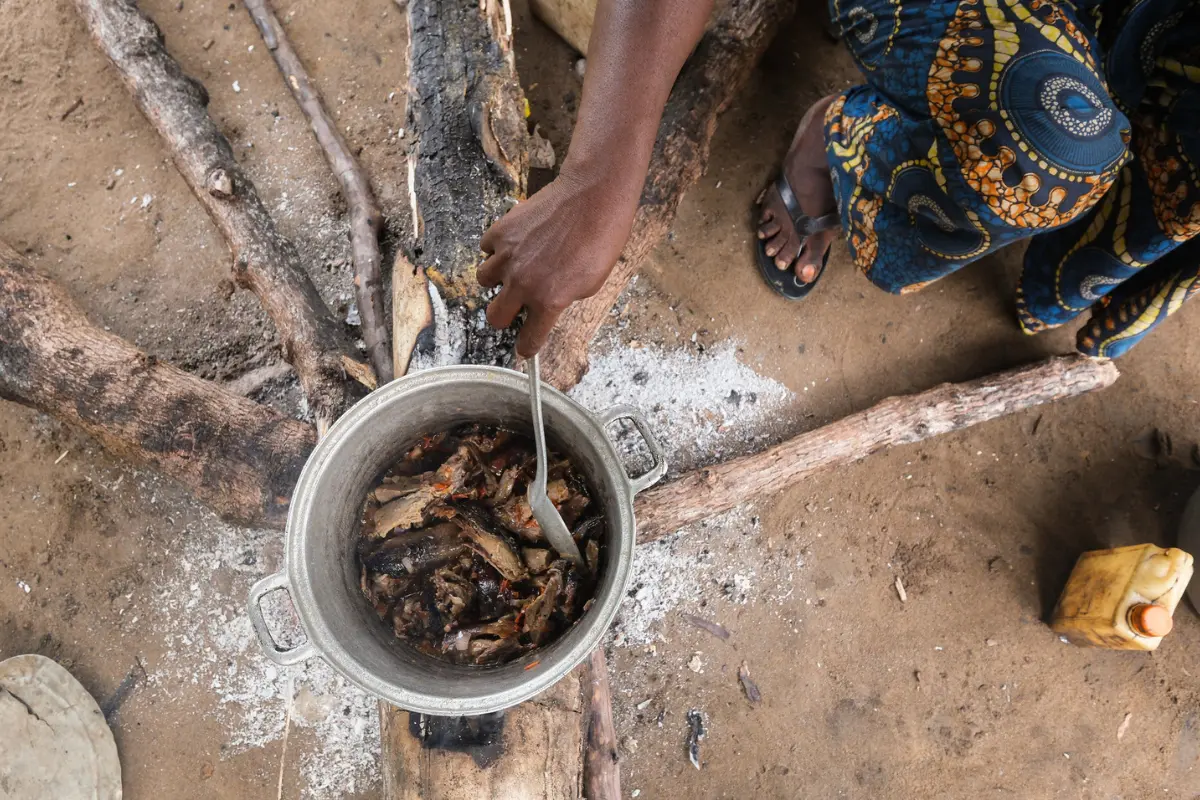
Photo: Bushmeat cooking in Yaselia Village, Tshopo Province – DRC. Axel Fassio/CIFOR-ICRAF
30 April 2026 – A study in Nature provides the first quantitative spatial and temporal analysis of wild meat consumption in Central Africa, revealing a sharp increase in demand that is largely driven by urban populations.
The total annual biomass of wild meat consumed across Central Africa has increased from an estimated 0.73 million tonnes in 2000 to 1.10 million tonnes in 2022. This increase is threatening wildlife populations and raising concerns about long-term nutritional security in rural areas.
Acknowledgements
These findings are the result of a collaboration between the Centre for International Forestry Research and World Agroforestry (CIFOR-ICRAF), the Durrell Institute of Conservation and Ecology (DICE) at University of Kent, the University of Stirling, the Centre for Advanced Study of Collective Behaviour (CASCB) at University of Konstanz, and the Institute for Research on Tropical Ecology (IRET) in Gabon.
Analysis for this study was supported by the EU-funded Sustainable Wildlife Management (SWM) Programme, which is currently piloting field projects in 16 countries. The initiative is implemented by a dynamic consortium of four partners, led by the Food and Agriculture Organization of the United Nations (FAO) with the Center for International Forestry Research and World Agroforestry (CIFOR-ICRAF), the French Agricultural Research Centre for International Development (CIRAD) and the Wildlife Conservation Society (WCS). Data was collected through the WILDMEAT project (www.wildmeat.org), which has been supported by the US Fish and Wildlife Service (USFWS), US Agency for International Development (USAID) and UK Research and Innovation (UKRI).