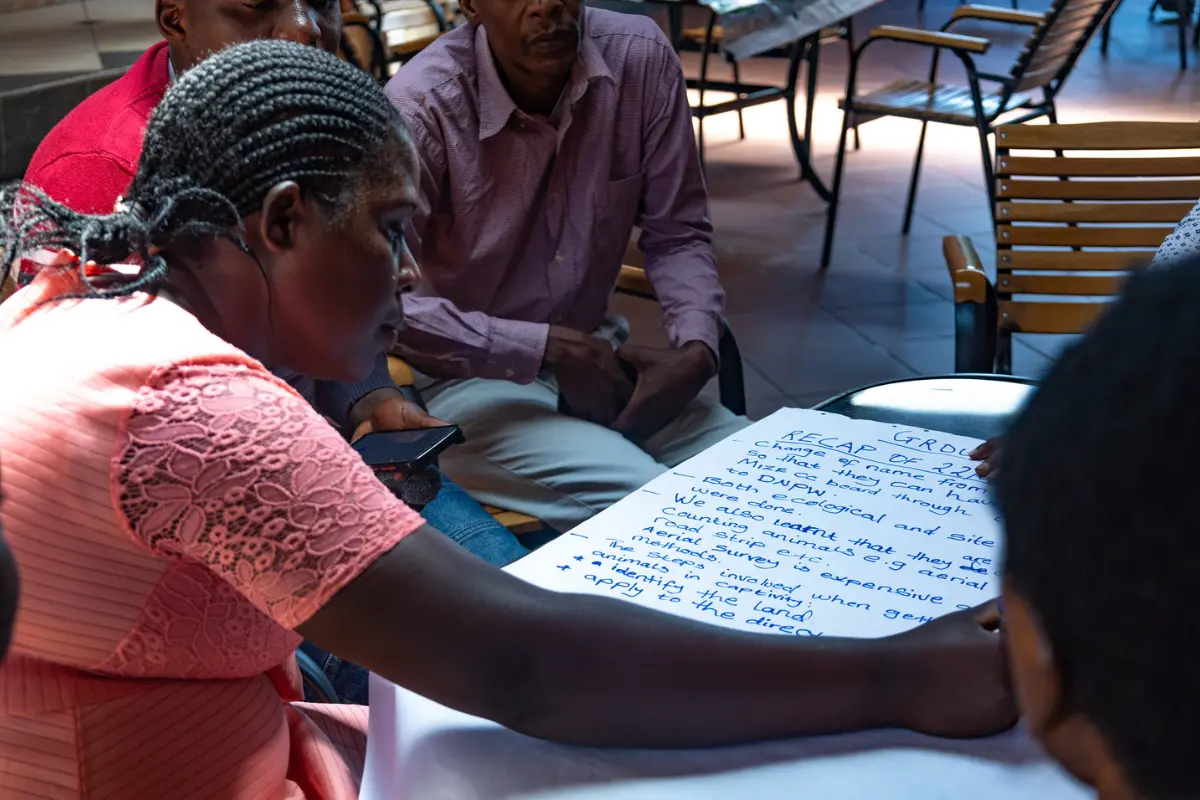
Participant contributing to a group exercise during enterprise development training for community cooperatives in Nyawa Chiefdom, southern Zambia. Photo by Landscape Alliance.
This content was originally posted on Forests News
17 Mar. 2026 — For nearly 25 years, Elliot Mudenda relied on hunting to support his family in Nyawa Chiefdom in southern Zambia. He had started as a farmer, but recurring droughts gradually made farming unreliable and unproductive.
With few alternative income options available, hunting became a means for survival.
However, Elliot knew the risks — the predawn darkness. The hours spent tracking game through the bush. The constant threat of wild animals. The fear of running into game rangers who could arrest him or getting injured.
“I never stopped caring about wildlife,” Elliot says, understanding his path was unsustainable. “But, I also had to survive.”
Today, Elliot has stopped hunting. Instead, he manages fish ponds as a member of the Sianyongo Fish Farming cooperative. The shift represents more than a change in occupation — it is part of a broader experiment in whether conservation can succeed by offering people viable economic alternatives.
The Sustainable Wildlife Management Program (SWM), funded by the European Union and implemented by the Center for International Forestry Research and World Agroforestry (CIFOR-ICRAF) and partners, is built on a simple principle: conservation cannot succeed where livelihoods fail.
Acknowledgements
The Sustainable Wildlife Management Program (SWM) is a major international initiative aimed at enhancing the conservation and sustainable use of wildlife in forest, savannah and wetland ecosystems. It is funded by the European Union, with co-funding from the French Facility for Global Environment (FFEM) and the French Development Agency (AFD). Projects are being piloted and tested with governments and communities in 15 participating countries. The programme is implemented by a dynamic consortium of partners that includes CIFOR-ICRAF, the Food and Agriculture Organization of the United Nations (FAO), the Wildlife Conservation Society (WCS) and the French Agricultural Research Centre for International Development (CIRAD).
In Zambia, the SWM Programme activities are carried out by the Government of the Republic of Zambia and Nyawa and Musokotwane Royal Establishment (NRE) respectively in collaboration with CIFOR-ICRAF