
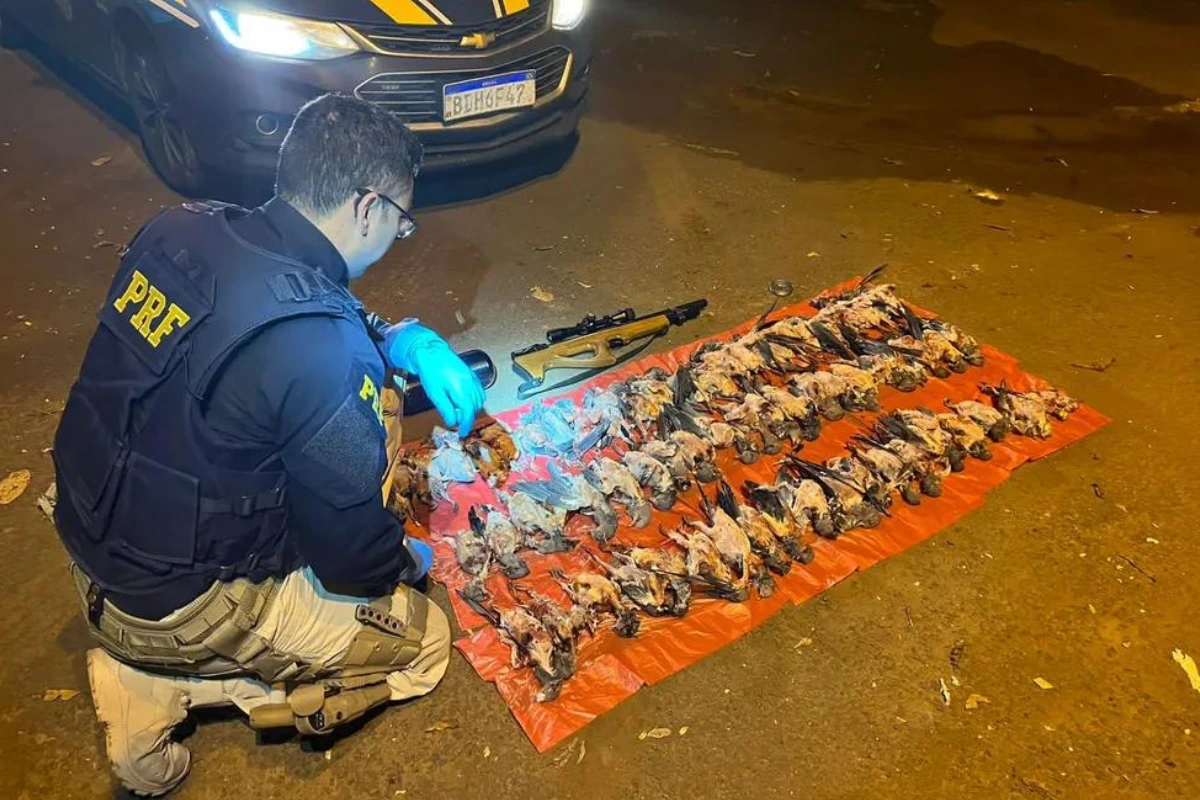
Hunter arrested with 66 dead wild birds in southwestern Paraná. Photo by PRF/PR
1 Apr. 2026 — A new study uses seizure records from Brazil’s Federal Highway Police (PRF) to uncover the scale and composition of illegal wild meat use at a national level.
Published in Perspectives in Ecology and Conservation, the study analyzes nationwide road-seizure records between 2017 and 2024 with a focus on hunted animals and wild meat intercepted during transport. It further tested whether seizure records matched ecological signs of defaunation (human-induced loss of animal populations), finding:
- Across 314 independent seizures, PRF intercepted about 9,479 animals, totalling 9.3 tons of biomass.
- The Amazon and Caatinga biomes accounted for the largest number of seizures and individual animals, respectively.
- Birds were the most frequently seized animals in the Caatinga and Pampa regions, while mammals accounted for the largest share of total biomass.
- Road-seizure data reflect defaunation trends; as larger animals become scarcer in degraded areas, people tend to catch more, but smaller, animals, including birds and reptiles.
Why it matters
Brazil is home to hyper-diverse ecosystems that are threatened by accelerating human-induced biodiversity loss. Illegal wild meat hunting especially affects ‘large-bodied vertebrates’ (e.g. mammals), whose decline can trigger cascading impacts on ecosystem health.
Illegal hunting is especially hard to monitor, and field-based data collection faces many legal and logistical constraints. Roadway seizures provide a unique and underused dataset that can act as “a cost-effective barometer of illegal wild meat use,” especially if agencies adopt standardized reporting.
What’s next?
The study calls for a targeted response, pairing police enforcement on highways and waterways with standardized inter-agency reporting (e.g. species captured, their biomass, geolocation found, and product form). It further recommends community partnerships, creation of livelihood alternatives, and improved communication about health risks to reduce demand for wild meat.
Acknowledgements
This study was financed in part by the Coordenação de Aperfeiçoamento de Pessoal de Nível Superior – Brasil (CAPES) and the Anhanguera-Uniderp University, for the scholarship to RWZ. The authors would also like to thank all the people involved in hunting seizures in Brazil and their priceless efforts to halt illegal hunting in Brazil.