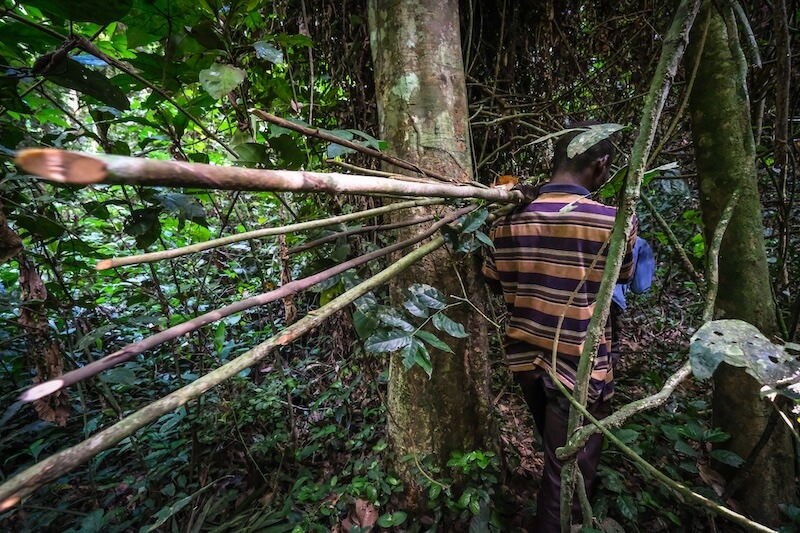
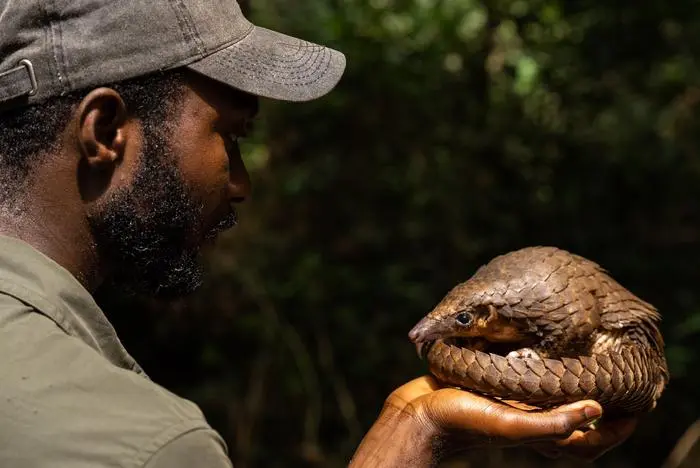
Photo: Collecting material for hunting traps in Yangambi, Democratic Republic of the Congo (DRC). Axel Fassio/CIFOR-ICRAF
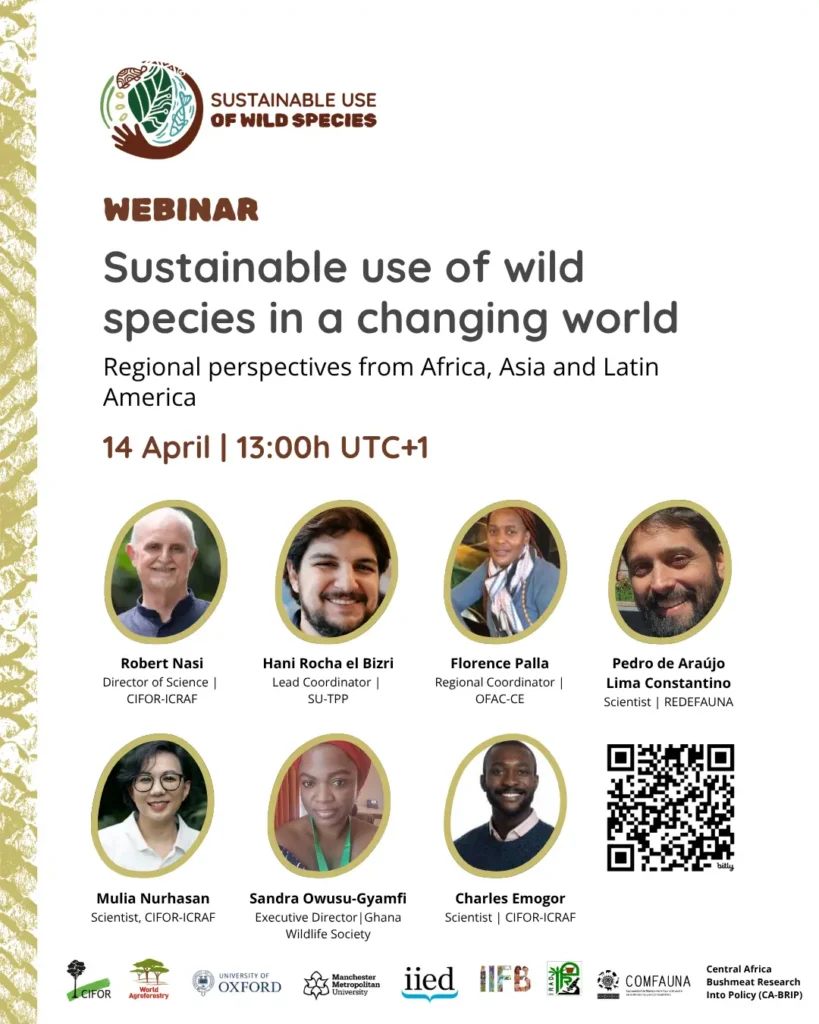
14 Apr. 2026 – The Sustainable Use of Wild Species Transformative Partnership Platform (SU-TPP) launched its first webinar with 318 participants from almost 70 countries across all continents.
Experts from diverse regions and disciplines came together to explore a timely question:
How can the ‘use’ of wild species for food, income or cultural traditions become part of the solution for a sustainable future?
“We chose the theme of sustainable use in a changing world for today’s webinar because the context in which wild species are managed is changing very rapidly,” said SU-TPP Lead Coordinator, Hani Rocha El Bizri, during his opening address.
“The effects of climate change, biodiversity loss, shifting food systems, disease risks and evolving policy agendas are increasingly interconnected.”
Drawing on over 15 years of experience working alongside local communities in the Amazon who practice subsistence hunting, he noted a clear shift in thinking towards recognizing that sustainable use is compatible with conservation and the rights of Indigenous People and local communities.
The newly launched SU-TPP aims to turn this recognition into action, aligning with the Kunming-Montreal Global Biodiversity Framework (GBF) and its mandate for sustainable, equitable and safe use of wild species—outlined in Targets 5 and 9.
“I believe this community of practice will have an important role to play in that transformation,” said El Bizri.
Refocusing around sustainable use
In his keynote, Robert Nasi, Co-Founder of the SU-TPP and Director of Science at the Center for International Forestry and World Agroforestry (CIFOR-ICRAF) traced the origins of the community back to 1999, when sustainable use was largely overlooked in global biodiversity discussions.
“At the time, everybody was working on conservation or on biodiversity benefit sharing, but we had forgotten the third element of the first declaration of the CBD [Convention on Biological Diversity], which was sustainable use,” he said. “We did not believe that ‘use’ could be sustainable.”
Today, the stakes are clearer. The latest IPBES report on sustainable use confirms that wild species are essential for millions of peoples’ food, income and cultural identity. Yet, they are often used in ways that are unsustainable, inequitable, and unsafe.
What is the SU-TPP?
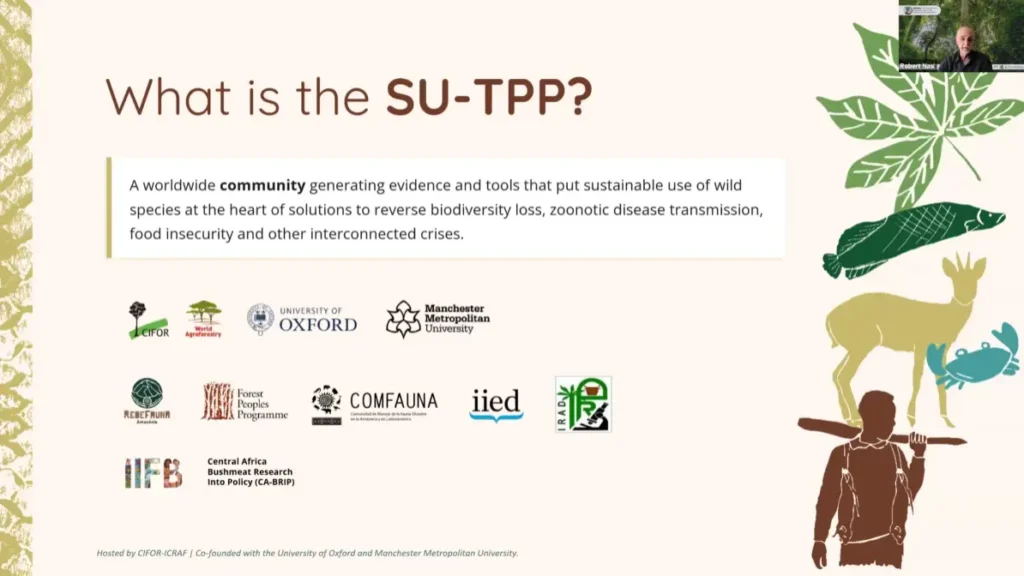
The SU-TPP responds to this complexity by fostering a community of practice that puts sustainable use at the heart of solutions to interconnected challenges like biodiversity loss, food and nutritional security, and zoonotic disease transmission.
Hosted by CIFOR-ICRAF and co-founded with the University of Oxford and Manchester Metropolitan University, the platform brings together research institutions, Indigenous organizations and civil society groups with a shared vision for a world where all wild species that people use are managed sustainably, equitably and safely.
Three features distinguish the TPP’s approach:
- Grounded research: Working alongside projects to co-produce evidence, attract new funding sources and connect researchers, especially in tropical regions.
- Investing in the future: Supporting early-career researchers and strengthening collaboration across regions. This is especially relevant for scientists in regions with limited access to institutional support, funding, and scientific publication. A future focus also means advancing integrated approaches to biodiversity monitoring and ecosystem management, including e-DNA, camera traps, local ecological knowledge surveys, AI-assisted data analysis.
- Beyond traditional conservation: Looking beyond protected areas to understand how wild species are used across entire landscapes, including farms, forests and coastal systems, ensuring these realities are reflected in policy and governance.
Similar trends across regions
Following the keynote presentation about the SU-TPP, moderator and Scientist at the University of Cambridge, Charles Emogor, opened a conversation on the biggest trends shaping how wild species are used and managed across Africa, Asia and Latin America.
Five key insights emerged:
- Many people use wild species; the conversation is not only about subsistence
“In West Africa, you see everywhere the use and high dependence on wild animals and plants,” said Sandra Owusu-Gyamfi, Director of the Ghana Wildlife Society. “…and it’s not only poor people who use these resources.”
Urban and higher-income consumers may also drive demand, paying a premium for wild meat or other products for cultural reasons or personal preference. Many species are traded for pets or medicine, for example—legally and illegally.
- Wild foods are undervalued in food systems
Wild and semi-cultivated foods contribute significantly to nutrition, yet they are often overlooked in policy.
“I think people often undermine the use of wild species thinking it is only food for very poor people and that once development takes place in the area, people will consume healthier safer food,” said Mulia Nurhasan, food and nutrition scientist at CIFOR-ICRAF and the Southeast Asia Coordinator of the NutriScapes initiative.
However, that is not always the case. Nutrient-rich wild foods are often replaced by ultra-processed foods when large-scale agricultural and urbanization projects overtake wild spaces. Nurhasan went on to say that research so far shows that plant and animal-sourced foods contribute a lot to peoples’ micronutrient and protein intake, but there is still work ahead to value wild species in food systems:
“It’s very important for policy makers to understand food system thinking in general… so that before you make a grand gesture that influences the food system, you also understand that there are always trade-offs and that the communities and governments are ready for those trade-offs. System thinking is very important for that.”
- Policies exist but often struggle in implementation
Many countries have laws regulating hunting and trade of wild species, but enforcement remains a challenge.
“Even if we have a beautiful and wonderful law, it’s difficult to implement,” said Owusu-Gyamfi, noting that people will continue hunting if viable alternatives are not available.
Strict regulations can also make research more difficult, as communities engaged in informal or illegal trade may be reluctant to share information. In these cases, working through trusted local organizations is essential.
- Pressures on wild species are increasing
All regions are experiencing increasing pressure on wild species.
In the Amazonian context, Pedro Constantino, a researcher specializing in the sustainable use of natural resources by traditional peoples in the Amazon, highlighted the impacts of climate change, increase in internet connectivity, rural-urban migration, and organized crime expansion on resource use.
On a more hopeful note, however, there is also a trend of large-scale community organizations working together to influence policy in Brazil, creating networks and working with government to recognize local communities use rights for key species.
Florence Palla, Regional Coordinator of the Center of Excellence for a Central African Forest Observatory (OFAC-CE), noted a similar trend in the Central African context of pressures from markets, consumption, deforestation and habitat destruction, traditional use, and illegal traffic.
- Indigenous and community management is essential, but still under-used
Amidst these different pressures, Palla prioritized sustainable management for the community level first “because they depend directly on wild resources.”
“We have to go beyond ecological considerations,” she said. “Beyond the quotas and data to take into account the traditional value of wild species and the social conceptions of what communities need.”
Yet participatory approaches remain inconsistently applied, and local knowledge is still not fully integrated into policy and research.
Together with other stakeholders, community management can help ensure wild resources are maintained for today and for future generations.
What’s next?
The conversation underscored that peoples’ use of wild species is no longer something that can be ignored in national policy and biodiversity conservation.
The SU-TPP invites researchers, practitioners, and policy makers to be part of the community seeking to achieve more sustainable, equitable and safe futures for all wild species.
Acknowledgements
The SU-TPP is hosted by CIFOR-ICRAF and co-founded with the University of Oxford and Manchester Metropolitan University.