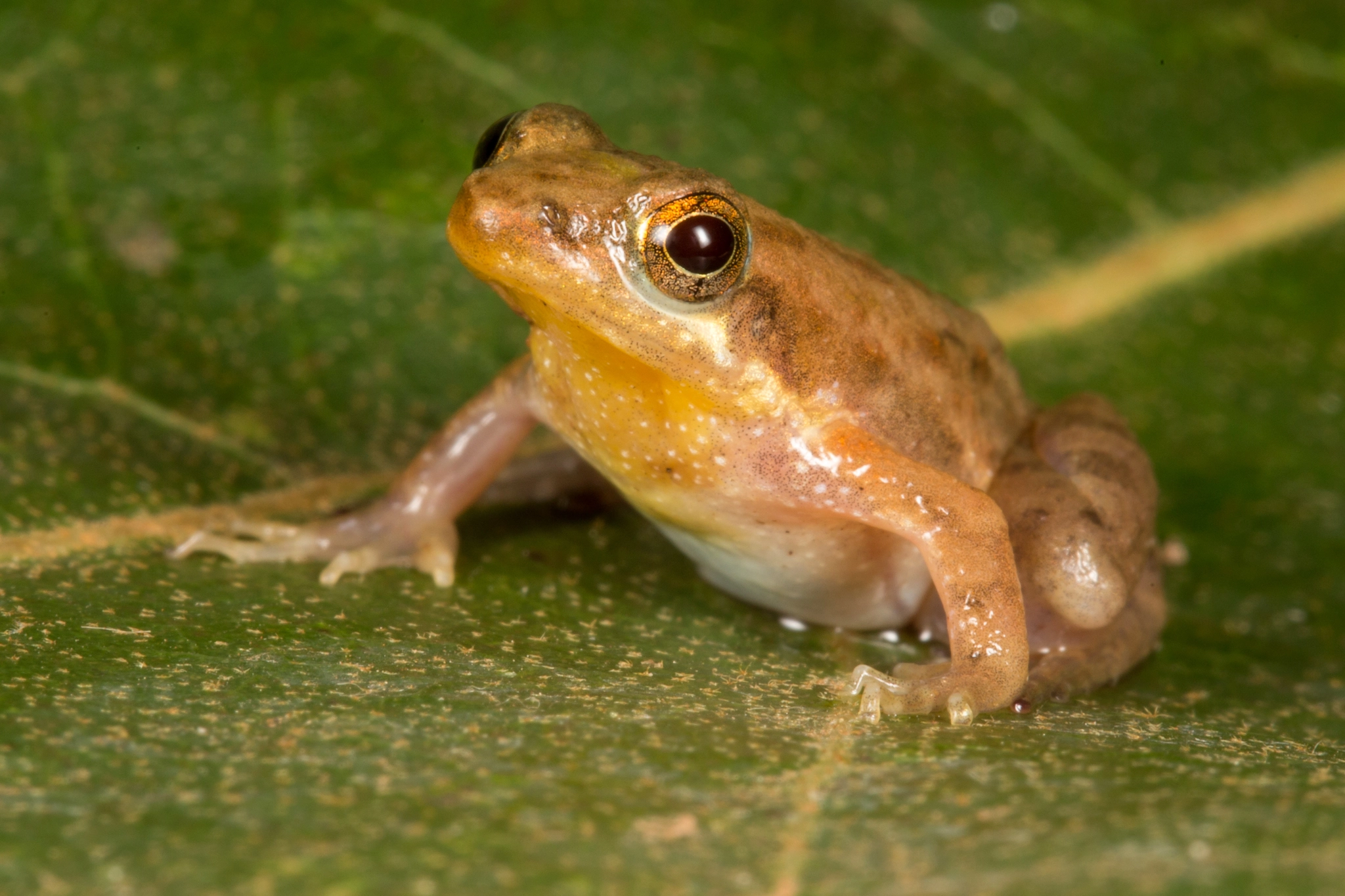
A broad-fronted puddle frog (Phrynobatrachus latifrons) perched on a leaf. Amphibians such as this are central to Sandra Owusu-Gwamfi’s research on sustainable harvesting and conservation in West Africa.
20 Feb. 2026 – When Sandra Owusu-Gwamfi was in high school, she never imagined she would one day be known as the ‘Frog Woman of Ghana’.
Like in many parts of the world, as many high-achieving students in Ghana, Sandra was expected to pursue medicine or to be funnelled towards the medical field. But a cousin came to her with a wilder idea—a new program at the Kwame Nkrumah University of Science and Technology that he said would be Ghana’s “next big thing”: environmental science.
“My dad was hoping I was going to change my mind eventually, but I didn’t,” she laughs. Today, with a PhD under her belt and numerous accolades as the country’s first female herpetologist — a scientist who studies reptiles and amphibians — even he has come around.
Her decision was cemented when she learned from her lecturers about leading women conservationists Jane Goodall and Wangari Maathai.
“I immediately fell in love with the whole concept of conservation,” Owusu-Gwamfi says. “The kind of passion they had…I was just amazed. I was empowered. I wanted to know more.”
Acknowledgements
This blog is supported by the Sustainable Use of Wild Species Transformative Partnership Platform (SU-TPP), a diverse community generating evidence and tools that put sustainable use of wild species at the heart of solutions to reverse biodiversity loss, zoonotic disease transmission, food insecurity and other crises. The SU-TPP is worldwide and includes policymakers, universities, practitioners, Indigenous Peoples and local communities.ervation Science in the Department of Biology at the University of Oxford and Forest Peoples Programme (FPP).