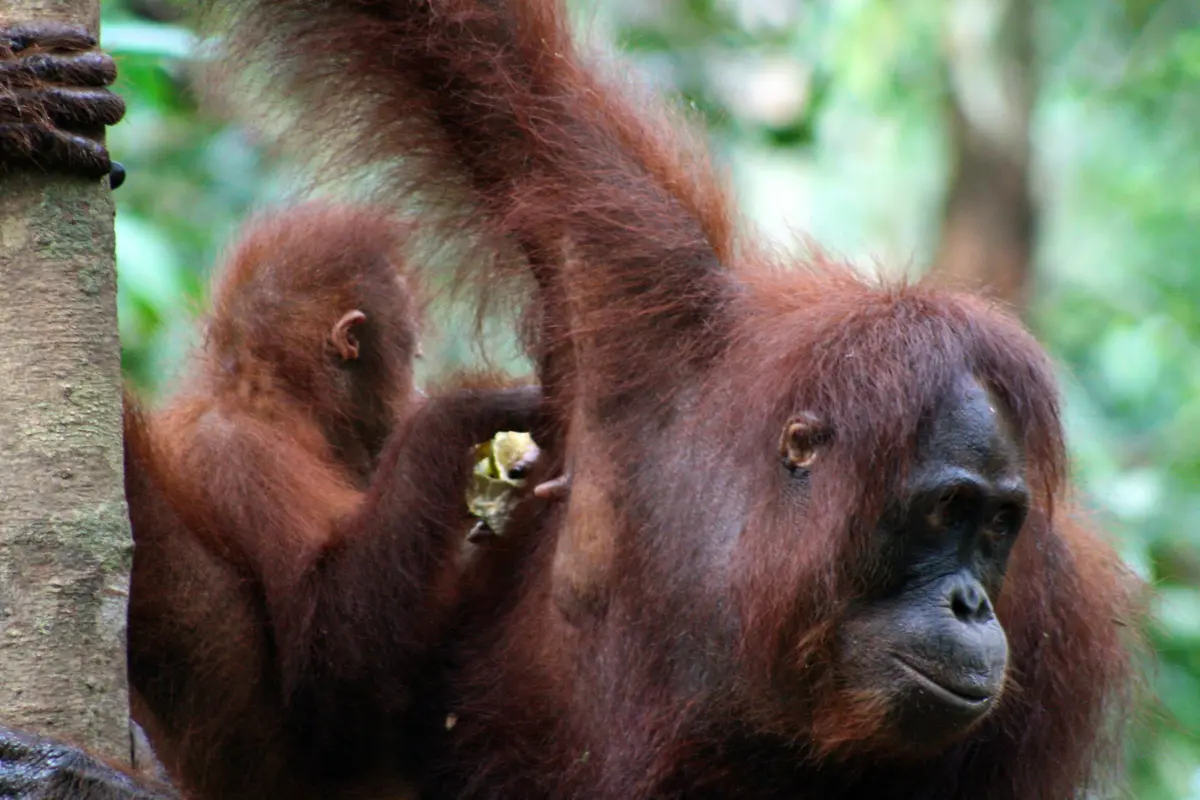
Photo: An orangutan mother and her baby. Terry Sunderland / CIFOR-ICRAF
15 May 2026 – When researchers from the Center for International Forestry Research and World Agroforestry (CIFOR-ICRAF) and local NGO Riak Bumi began surveying Bornean orangutan [Pongo pygmaeus pygmaeus] populations in Kapuas Hulu, West Kalimantan, in the early 2010s, they came across something “rather strange”, says CIFOR-ICRAF scientist Linda Yuliani.
Two forest areas, both in good condition by standard measures, showed dramatically different results. One had high densities of orangutan nests (the proxy the scientists used to determine population sizes for the notoriously elusive animals). The other had none.
The biologists on the team were befuddled. But their anthropologist colleagues had a hypothesis. “They told us that in the forest with a lot of orangutan nests — in the Iban Dayak [local Indigenous group] area — there was a strong traditional knowledge system applied by the local communities,” says Yuliani.
“They have a number of very well-known folktales that encourage people to protect the animals, and support strong norms and taboos about not disturbing orangutans.”
Acknowledgements
For more information on this project, please contact Linda Yuliani: L.Yuliani@cifor-icraf.org